
Weed Control Options for Organic Growers
Don't Do Nothing, Yet Do as Little as Needed

There are a basic few things that plants really need to thrive. Those are sunlight, water, warmth, and food (some of which they make themselves). We can argue about the details, but suffice it to say that a shortage or imbalance of any of these basic essentials doesn’t bode well for plant growth. So far this year we’ve had modest sunlight (long periods of clouds and overcast skies), plenty of water (it can stop anytime now), little warmth (except for small stretches), and food (which is rarely an issue) hasn’t been so far this year. This all means that the main competitors to our crop plants - weeds - are thriving. Many weeds thrive in cool, wet, cloudy conditions, when our crop plants prefer the opposite. So, how does one manage weeds in a cropping system that doesn’t prefer weeds in a year that encourages them? The answer: not easily - but there are options to make the situation easier.
Weed Control for the Organic Grower
Let me start by saying that conventional herbicides work, and they work well. Nobody would use them if they didn’t. A combination of pre- and post-emergent herbicides can go a long way to controlling weeds, improving production (think volume, not quality), and keeping down costs. But they come at a huge cost to the environment, soil fertility, biodiversity, tree health, human health, food quality, and, as we’re seeing with glyphosate, they eventually fail. That said, weeds (wild plants) do provide a huge challenge for organic growers of perennial crops.
Not All Weeds Are Created Equal
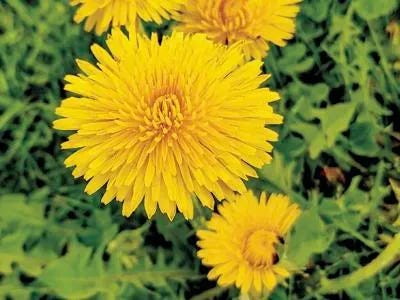
While most organic growers strive for low maintenance, high biodiversity, optimal productivity and quality - and are therefore accustomed to some weeds - not all weeds are created equal. Some can be very detrimental (e.g., bittersweet, wild snapdragon, poison ivy), while other can be very beneficial (e.g., yarrow, valerian, dandelion). So the trick is find a place with your weed management that balances, cost, productivity, aesthetics, and ecosystem health.
Weed Control Options - a Brief Introduction
Here are weed control options that we have in front of us. While the vines and trees are so young, they are limited, so no damage is done. But as the trees and vines mature, more options open up to us.
Conventional herbicides - not an option since they do not comply with organic management practices.
Organic Herbicides - an option, but not effective except in a very intensive application program. Meaning that early and repeat applications are needed. Once weeds get too tall and tough, the materials are ineffective. Plus they will burn any new tissue, so for the grapes or trees at an early stage of their life, herbicides are not an option. Homeplate is the ONLY material I’ve had any luck with. Its basically a strong, fancy, and $$ vinegar.
Burndown - using a flame weeder can work, but presents certain hazards such as injuring the plants, melting irrigation tubing or other plastic, and setting the farm on fire. Plus there is a HUGE carbon footprint involved.
Mechanical cultivation - there are several tools here, but all involve $$ (the implements are expensive), tractors and technical machinery skills. In some cases the vineyard or orchard need to have been designed with this kind of cultivation in mind, which was not the case for most organic plantings. Klemens and Rinieri are the two companies that make widely used equipment - all of it is expensive, and it would take establishing appropriately from the start or involve a retooling of an vineyard and orchard to make this work without damaging the plants.
Livestock - sheep can provide some level of weed control but can also eat the crop plants, and they require a different level of care and attention. Meaning, in large part, they can’t be left on their own, need to be field rotated, fed, and require other care (e.g., vets). Plus the vines and trees are too young to consider this option right now, but in 3-5 years it could be an option. They are great for soil fertility and biodiversity. Some breeds are better than others, but that’s a discussion for another time. NOTE: I am an advocate for livestock in orchards and vineyards, but I am by no means an expert. Plus I like to take my winters off.1
Woodchips - woodchips provide decent weed suppression, but as they break down, they turn into soil and provide a rich growing environment for all plants. That said, the benefits of woodchips far outweigh the disadvantages (advantages: moisture retention, soil fertility, carbon sequestration, weed suppression, biodiversity; disadvantages: need reapplication every 2-3 years, cost of application machinery, do not control weeds 100%, sourcing of appropriate mixes of woods).
Weedwhackers - They are effective in knocking down weeds, though they do regrow. Requires machinery (there are effective electric models), they’re noisy, leave plastic string bits all over the place, and can damage plants (I’ve seen more of this in my lifetime than I would care to remember).
Cover crops/Companion plants - this has been studied over the years and has shown “some” promise. But the correct non-competitive seed mix, ratios, planting, and management all mean this is not 100% effective, takes time and money, and still hasn’t been widely adopted by grape growers in the US (there is more of this practice in Europe than anywhere else). Try a small planting of buckwheat underneath some vines this year (1 - on soil prior to woodchips, 2 - on woodchips) using the “seed ball” approach where the seeds are soaked overnight in a moistened, clayey soil or compost, then spread evenly but by hand. Then you wait. There are other plant species options, but start here. BW is not overly competitive, doesn’t get too tall, flowers and seeds quite easily, is great for bees, and it can reestablish itself. That said, it doesn’t like hot weather and needs moisture to establish and grow (like all plants).
Intracropping - a variation on the theme of intercropping and companion plants is the idea of intracropping, or growing a second crop in the same rows as your trees or vines. In fact, growing vines in your tree rows (or trees in your vine rows) is a unique, and ancient, cropping concept called married vines (or trees), or Vita Maritata.2 Personally, I find the idea of growing vines in my apple trees a little unsettling. as grape vines (Vitus spp.) can take over like few other plant species. Proper species and varietal selection for modest to low vigor is needed for system like this to work for both crops. More interesting is intracropping with plant species that support both regenerative and food objectives. Plants like grains, herbs, sprawling cucurbits, and berries (e.g., currants, gooseberries, raspberries, blackberries, etc.). There are others I am sure. However, no matter which direction you take, it requires proper planning and execution to ensure that everything thrives, produces, and supports your regenerative objectives. And an intracrop doesn’t necessarily require it to be a food plant for humans, it could be a food plant for pollinators or other beneficials insects, even the phyllobiome benefits!!
Hand weeding - time consuming, expensive, never-ending, never fully effective (you always leave roots behind that simply regrow many weeds).
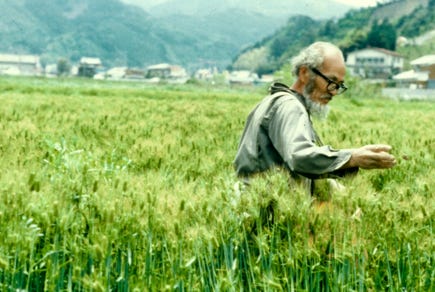
Fukuoka’s Do Nothing - While this is very much an option, it is not preferable because the wild plants/weeds that may be coming in are very competitive and could quickly take over a planting, as we are already seeing in some plantings. As plantings mature, then a transition could take place. Masanobu Fukuoka, author of One Straw Revolution, is revered for his ‘do nothing’ approach, but was actually quoted as saying: “don’t do nothing, do as little as needed.” Let nature guide the way.
Fukuoka believed that “the earth cultivates itself naturally” and that the ultimate goal of farming was not just crop production, but “the cultivation and perfection of human beings” through harmony with nature.
What to Do?
In the end, almost all of the above weed control practices are options. In reality, and in practice, it will take a combination of them to achieve effective, yet not perfect, organic weed control. And which ones you choose and how you use them depends on the variables in your life and operations that are largely out of anyone’s control but your own. So, don’t despise the weeds; enjoy the dandelions and flowers, the birds and the bees, the beneficials you can barely see. Do what’s needed to make sure your crop plants are providing what you need for both productivity, profitability, quality and peace of mind.
“Don’t Do Nothing, Do As Little As Possible - then write some haiku.”
More on this soon I hope. I will be working with a local shepherd about bringing sheep onto the orchard fir a limited time. We’ll see how it goes and, if it works, we can expand to larger sections and time periods.
My friend and compatriot Adam Huss has a podcast - Beyond Organic Wine - where he discussed numerous cutting edge concepts and practices, including syntropic agroforestry (that includes concepts like married vines). Here is a link to one of several interviews he’s done re: married vines. Enjoy! Or in this case, is it Enjoin?
I loved reading this- the humour, the logic, the optimism- all just what I needed.
I’m gonna try 4 oz of solubor per gallon under-vine to burn young weeds and satisfy my boron requirements. John Kempf wrote about this technique a while back….